
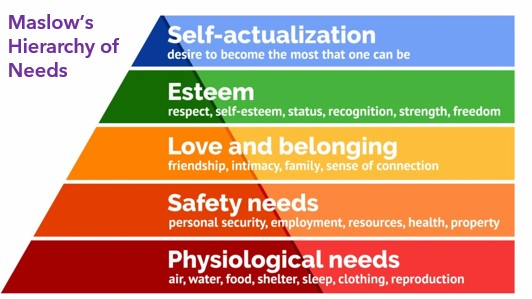
Personal authenticity has become a defining trait of effective leadership and meaningful human connection. But how would you define authenticity? Psychologist Abraham Maslow created Maslow’s hierarchy of needs illustrated above as part of a motivational theory that explains how human needs build from basic to complex. It proposes that people must first meet essential physiological and safety needs before they can focus on higher-level needs like belonging, esteem, and self-actualization. Maslow simply defined authenticity as, “zero phoniness”. This is how you want people to think of you. The real you, always true to your values.
At its core, authenticity is the alignment of values, beliefs, and actions. It requires self-awareness, honesty, and the courage to resist conformity with social norms or peer pressure. In a world that is often happy with surface-level performance, choosing authenticity is not always easy – but it is essential for building trust, credibility, and long-term success.
Personal values function as your internal compass. They guide decisions, shape behaviour, and influence your responses. Whether rooted in faith, integrity, empathy, or accountability, values provide a stable foundation in uncertain environments. Beliefs, alongside values, reflect how individuals interpret the world and their role within it. For leaders, values and beliefs inform not only what they do, but why they do it. When leaders operate in alignment with their vision and values, they demonstrate consistency, which nurtures trust among their teams.
My dad, when reminding me of the house rules, would often say,” My ball, my bat, my wickets!” Authenticity is not rigidity, however. The notion that authenticity requires relentless unwavering devotion to your personal perspective is, I believe, misplaced. In reality, authenticity also involves the willingness to listen, learn, and for attitudes to be reshaped without compromising core principles. Finding balance becomes particularly precarious when it comes to leadership, especially where diverse teams bring a wide range of personalities, experiences, and viewpoints. Managing a team of diverse characters presents both an opportunity and a challenge. Diversity of thought can drive creativity, innovation, and better decision-making. However, it also introduces complexity in communication. Leaders must navigate differing values, work styles, and expectations while maintaining cohesion and direction. This is where authentic leadership becomes demanding but indispensable.
An authentic leader does not attempt to mould every team member into a common shape. Instead, they recognize and respect individuality, creating an environment where people feel seen, heard, and valued. This requires emotional intelligence – the ability to understand and respond to the needs and motivations of others. It also demands adaptability, as different individuals may require different approaches to communication, feedback, and support.
At the same time, leaders must remain anchored in their own values. Without this, efforts to accommodate diverse perspectives can lead to inconsistency even loss of direction. The challenge lies in finding the sweet spot between flexibility and firmness, being open to other views without forfeiting your own. Leaders who achieve this balance are better equipped to build inclusive cultures where diversity is not just tolerated, but becomes a strength.
Ultimately, personal authenticity is not a fixed state. It involves continuous reflection, honest self-assessment, and the willingness to align actions with deeply held principles. For leaders, this journey is particularly significant. Their authenticity sets the tone for their teams, influencing not only performance but also culture and morale.
In an increasingly complex and diverse world, authenticity is more than a personal virtue – it is a leadership imperative. Those who embrace it thoughtfully will not only lead more effectively but also create environments where others can do the same.
Stewardship Wealth is a company built on the leadership model we’ve shared and discussed openly as well as in this article. It involves clear vision and values, building a culture around those key components and finding people who can stand behind them, and the leader out front.
The issues we’ve discussed; authenticity, consistency and finding a balance between single-mindedness and supportive collaboration have been in play for the last 8 years. Simon has managed to walk the tightrope of leading, building, and supporting others without letting his vision or values anchors drift. Quite an achievement. He has led a business that operates in sharp contrast to the prevailing industry’s profit chasing mind set, doing things his way, but allowing, even nurturing people’s ability to express themselves in their own way.
Authentic leadership is alive and well at Stewardship Wealth. Our vision and values persist. Interestingly, looking at Maslow’s Hierarchy of Needs, you will see that our goals link to meeting those needs. Food, clothing and shelter, and a sense of belonging and connection through supporting local church and charity organisations. Funding counselling for ex-offenders and others trying to break cycles of damaging behaviours and those seeking to regain a sense of self-esteem, and strength to keep trying. Our goal of recruiting and training speaks directly to aiding self-actualisation, to strive to achieve professional recognition and find their place in a fulfilling career supporting others achieve their own ambitions.
The good news is our vision, values and goals remain firmly anchored, and authentic leadership continues to motivate us as we continue our adventure in year nine, ten, eleven…